Évora Portugal in 24 Hours & the Bone Chapel
We arrived in Évora just before noon on one of the last carefree travel days before the world changed. It was early March 2020, the weather was mild, an undecided mix of sunshine and cloud. We had less than 24 hours in Evora before our bus to Lisbon the following afternoon. We didn’t know yet that within weeks, borders would close and trips like this would become impossible for a long time.
Looking back, I’m glad we didn’t know. We wandered Évora exactly as you should: unhurried, unworried, gloriously lost in its narrow whitewashed streets.
Evora Summary
Location: Alentejo region, Portugal
When to go: March–May or September–October are the sweet spots. July and August are fiercely hot and busy.
Time spent: Just under 24 hours — arrived midday, left late afternoon the next day. Could do as a day trip but possibly tight on time.
Getting there: Bus from Albufeira, Lisbon or Porto
Highlights: Chapel of Bones, cathedral rooftop, Roman temple, wandering the whitewashed medieval streets
Best for: History lovers, day-trippers from Lisbon, anyone who wants to see a side of Portugal that isn’t the coast
Getting There
We came by bus from Albufeira in the Algarve — a straightforward, comfortable journey. Évora sits in the Alentejo, Portugal’s vast interior plain — wheat fields, cork oaks, olive groves, and a pace of life that feels deliberately removed from the coastal tourist trail.
If you’re coming from Lisbon, Évora is an easy day trip or short travel day. The journey is about 90 minutes by bus from Lisbon (Sete Rios terminal). From the Algarve, buses connect via Albufeira or Faro, roughly 3–4 hours. From Porto, it is about a 6-hour bus ride.
But I’d argue it deserves at least an overnight. The city changes character after the day visitors leave, and the morning light on the whitewashed walls is something worth waking up for.
The City Itself: A Medieval Maze
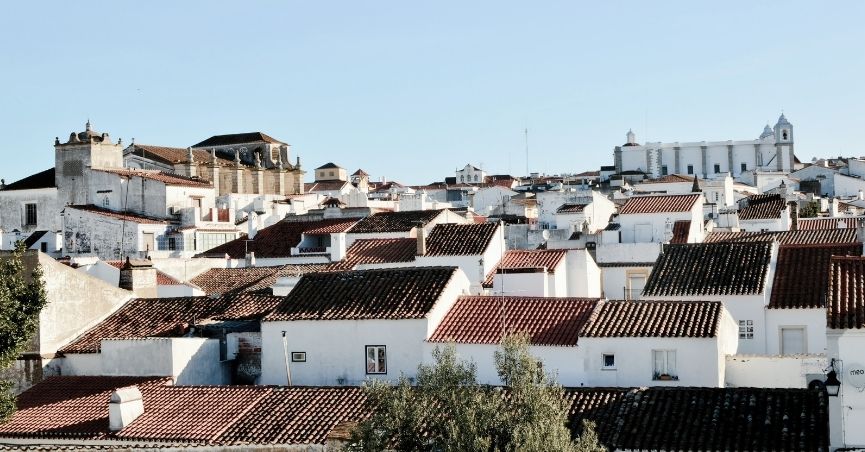
Évora is a UNESCO World Heritage Site, and within about ten minutes of arriving, you understand exactly why. The old city sits within medieval walls, its street plan essentially unchanged since the Middle Ages — winding, narrow, haphazard, and completely wonderful to get lost in.
Everything is whitewashed. Bright white walls, terracotta rooftops, wrought iron details, and the occasional vivid tile panel. The streets curve and fork without logic, open unexpectedly into small squares, and lead you past Roman ruins, Gothic doorways, and Manueline flourishes all within the same short walk. There’s no straight line between anything, which is entirely the point.
We wandered without a destination for the first hour, and it was the best decision we made. Wear comfortable shoes as the streets are cobbled and uneven throughout.
One of the more surreal aspects of the city is the Roman aqueduct — the Silver Water Aqueduct, built in the 16th century on Roman foundations — which runs directly through the urban setting. Not past it, not around it: through it. Buildings have been constructed alongside and against the aqueduct arches over the centuries, incorporating the ancient structure into their walls as naturally as a doorframe.


What We Saw: The Highlights
Temple of Diana (Roman Temple)
Right in the heart of the old city, surrounded by modern café terraces, stand fourteen Corinthian columns from a Roman temple built in the 1st or 2nd century AD. The “Temple of Diana” name is a misnomer from later centuries — it was more likely dedicated to the Imperial cult. But the columns themselves are extraordinary: tall, intact, golden in afternoon light, and completely incongruous against the medieval city around them. Just ancient Rome, in the middle of a city that kept building around it for two thousand years.
Cadaval Palace and Loios Church
The Gothic Church of St. John the Evangelist — known as Loios Church — sits adjacent to the Roman temple and contains some of the most beautiful azulejo tilework in the Alentejo. If you thought you left this behind in Porto, don’t worry, you didn’t. Blue and white panels covering the interior walls, depicting scenes from the life of St. Lawrence Justinian with extraordinary detail. The Cadaval Palace, alongside it, has been home to the same noble family for centuries, and parts of it open to visitors.
The Cathedral: Go Up to the Roof
Évora’s Sé — its cathedral — is the largest medieval cathedral in Portugal, begun in the 12th century and added to across several hundred years. The interior is impressive in that solid, weighty Romanesque way, but the real reason to visit is the roof.
Access to the cathedral rooftop is easy — the ascent is mostly flat and straightforward. What you find up there is genuinely lovely: ornate stone balustrades creating a fence-like barrier along the edges, a tower rising as a beautiful backdrop, and views across the entire city and out into the Alentejo plain beyond. The rooftop gives you the one thing the winding streets below don’t: a sense of the shape and scale of Évora from above. Terracotta and white as far as you can see, the countryside beyond the walls stretches flat and golden to the horizon. Go up. It’s worth every step.
King Manuel’s Palace
The remains of the Royal Palace of King Manuel I sit near the Giraldo Square. Évora was once one of the most important cities in Portugal. This palace was a favoured residence of the royal court during the Age of Discovery. What remains is fragmentary but atmospheric, the Manueline style (Portugal’s own late Gothic flourish, all maritime imagery and organic ornamentation) visible in the surviving details.
The Public Gardens
A peaceful pause between sites — formal gardens laid out on the site of a former Moorish fortification, with views over the city walls and the countryside. Good for a slow coffee or simply sitting in the February sun before the afternoon’s main event.


The Bone Chapel: The Thing You Came For
I want to be careful about how I describe the Chapel of Bones at the Church of St. Francis, because it’s easy to either sensationalize it or undersell it, as it deserves neither.
Above the entrance, carved in stone, are the words:
“Nós ossos que aqui estamos, pelos vossos esperamos.”
“We, the bones that are here, await yours.“
Read that before you go in. Let it settle. Then step inside.
The chapel was built by Franciscan monks in the 16th century using the bones and skulls of approximately 5,000 people, who were exhumed from the city’s overcrowded cemeteries. They were used to construct something that is simultaneously a meditation on mortality, a work of art, and one of the most unique spaces I have ever stood in.
The effect is eerie and peaceful simultaneously. Morbid and artistic in the same breath. You don’t feel confronted by death here. You feel invited to consider it, quietly, in a space that takes the consideration seriously.
What makes Évora’s chapel different — and I say this having also visited the famous bone church at Kutná Hora in the Czech Republic — is the way the bones are used architecturally. In Kutná Hora, the bones function as decoration: chandeliers, garlands, ornamental arrangements that are genuinely spectacular but feel, almost, theatrical. In Évora, the bones are the structure. They line the walls like a material, column to column, floor to ceiling. Skulls and femurs lay in patterns that create something between wallpaper and masonry. Two mummified bodies hang at one end. The vaulted ceiling arches overhead.
The Franciscan philosophy behind it was straightforward: a reminder that earthly life is temporary and the soul’s journey is what matters. The monks who built this were not trying to shock. They were trying to teach. Somehow, five centuries later, it still works.
I found myself moving through it slowly, in near silence, and leaving with something I couldn’t quite name — not discomfort, not fear, or disgust, but something closer to perspective. If you go to one thing in Évora, go to this.
Tips/Logistics
Entry is ticketed and separate from the main church. Go in the morning if you can; it gets busier through the day. The contemplative atmosphere is harder to find when it’s crowded. Photography is permitted. Be respectful — it’s a sacred space as much as a tourist site.


Food and Drink: Alentejo at the Table
The Alentejo is one of Portugal’s great food regions — and Évora is the place to eat it properly. The cuisine here is hearty, unfussy, and deeply rooted in the landscape: black Iberian pork (some of the best in the country), migas (a bread-based dish, rich and satisfying), slow-cooked lamb, and game. Alentejo olive oil and Alentejo wine — full-bodied reds and increasingly impressive whites — belong on the table alongside everything.
We tried the local almond tarts — delicate, not too sweet, the kind of thing you eat one of and immediately want another — which are among the better things I put in my mouth in Portugal.
If you’re looking for a restaurant recommendation, ask your accommodation — Évora’s best places tend to be small, local, and not heavily reviewed online. The city hasn’t been overrun by tourism in the way the Algarve coast has, and the food scene reflects that.
Pin me to read later…

Check out our other Portugal posts: