4 Days in Luxembourg: Itinerary for First-Time Visitors
Luxembourg is easy to underestimate. It’s small — one of the smallest countries in Europe. And sitting quietly between France, Belgium, and Germany, it is often overshadowed by these larger neighbours. But spend a few days here, and you will immediately wish for more time.
It all began in 963, when Count Siegfried built his castle of Lucilinburhuc on a rocky promontory above the Alzette River. From that single fortification, a city grew. Over the following centuries, the Burgundians, Habsburgs, Spanish, French, Prussians, and Austrians all took turns controlling it. Each group adds to its formidable defences. Until Luxembourg earned the nickname: “Gibraltar of the North”. During the French Revolutionary Wars, the city held out against a French siege for seven months with its walls still unbreached.
Today, Luxembourg is a financial powerhouse, an international hub with three national languages, and is a founding member of the UN, NATO and EU. The old town and its fortifications are a UNESCO World Heritage Site, the Moselle Valley produces some of Europe’s most underrated wines, and the countryside beyond the capital holds medieval castles, river gorges, and quiet villages.
Four days are enough to scratch the surface. Barely. Here is a four-day itinerary with a little mix of what Luxembourg has to offer.
Luxembourg Summary
- Who it’s best for: History lovers, architecture enthusiasts, and wine drinkers
- When to visit: Late April through October is ideal — spring for fewer crowds and lush green gorges, summer for full opening hours and the Moselle in full swing, shoulder season for quieter streets
- Currency: Euro (€)
- Language: Luxembourgish is the national language, but French, German, and English are all widely spoken
- Highlights: Casemates du Bock and Chemin de la Corniche in Luxembourg City, Vianden Castle, hiking the Mullerthal Trail near Echternach, wine tasting in the Moselle Valley
- Good to know: Public transport is completely free in Luxembourg — buses, trams, and trains
Where to Stay
Day 1: Luxembourg City
Luxembourg City is compact enough to cover a lot of ground on foot. Start where the city itself started — at the Bock promontory.
Casemates du Bock
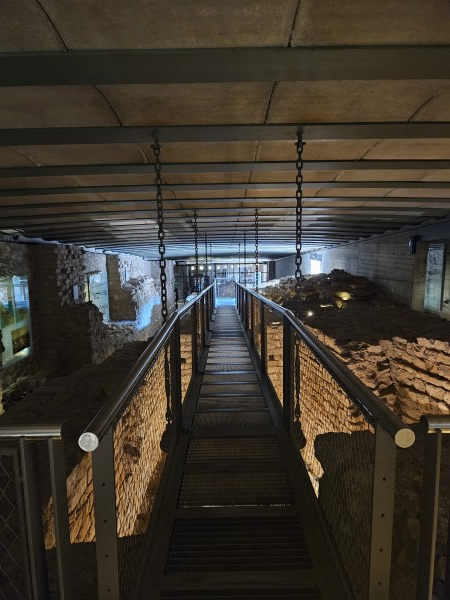
The Bock is the rocky promontory where Count Siegfried built his castle in 963. The foundation for everything that followed. What remains today are the ruins of the fortress above ground and below it. A honeycomb of tunnels carved into the rock over centuries of occupation. The Bock Casemates are a subterranean defence system made up of kilometres of tunnels. Initially carved in the 17th century under Spanish rule, and subsequently extended twice. At their peak, they could house 1,200 soldiers, along with kitchens, bakeries, workshops, and stables. An entire military city hidden underground. Give yourself at least an hour, and pick up the audio guide — the context makes the tunnels significantly more interesting.
Chemin de la Corniche
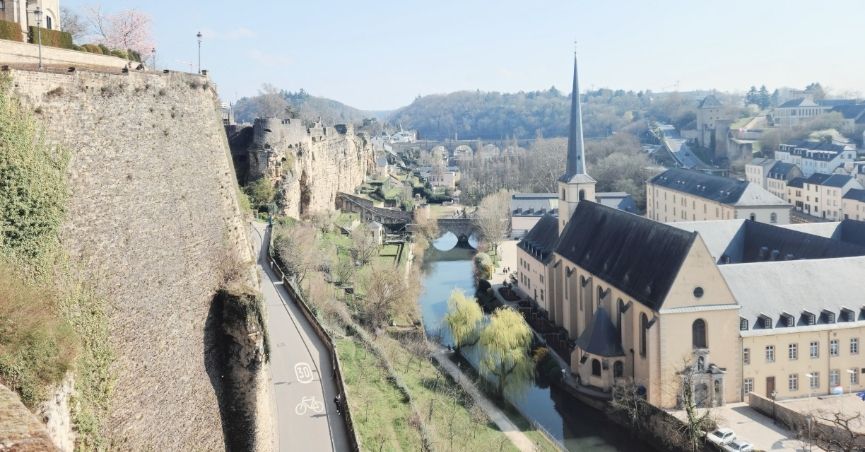
Emerging from the casemates, follow the Chemin de la Corniche along the cliff edge. Often called the most beautiful balcony in Europe, the Corniche path leads you back through the old town with sweeping views over the Grund neighbourhood below and the Alzette River valley beyond. It’s one of those walks that looks good in photos but is even better in person. Go in the morning before the day-trippers arrive.
The Grund
You have a choice, you can descend into the Grund — the valley neighbourhood that you’ve been admiring – now or save it for the evening and dinner.
This is Luxembourg City at its most atmospheric: narrow cobbled lanes, the Alzette winding quietly alongside, old stone bridges, and a cluster of bars and restaurants that come alive in the evening. Many say it’s worth a wander both morning and night as the neighbourhood transforms after dark. Candlelit restaurants, wine bars, and a relaxed pace. It’s the best place in the city to eat well without trying too hard to find somewhere.




Sights in Upper Town
Notre-Dame Cathedral & Grand Ducal Palace
Staying or returning to the Upper Town, consider popping into the Notre-Dame Cathedral. It’s more striking than its exterior suggests, with beautiful stained glass and an ornate crypt. The Grand Ducal Palace next door is the official residence of the Grand Duke. It is a lovely example of Renaissance architecture. You can’t go inside outside of the summer guided tour season, but the exterior and the surrounding square are photogenic.
Place Guillaume II
Luxembourg’s main square — locally called Knuedler — sits at the heart of the upper town. The city hall occupies one side, there’s a market on Wednesday and Saturday mornings, and it’s a good spot to sit with a coffee and watch the city move. Quieter and more genuinely local-feeling than you might expect from a capital city.
Citadelle du Saint-Esprit
A short walk from the main square, the Citadelle du Saint-Esprit sits on a raised plateau at the edge of the old town. If you’re obsessed with the Chemin de la Corniche views, definitely stop here. It has some of the best panoramic views in the city — across the valley, over the Grund, and down toward the Kirchberg. It’s often overlooked in favour of the Corniche, which makes it a reliably quiet spot. Go late afternoon for the best light.
National Museum of History & Art
If you have an afternoon to spare, the National Museum of History & Art is genuinely excellent. Head to level -2 for the Roman mosaic, one of the finest examples in northern Europe and an unexpected highlight. The museum covers Luxembourg’s history from prehistoric times through to the present, and the archaeological collections are particularly strong.
Dinner
If you are still in Upper Town, try Brasserie du Cercle for some Luxembourg traditional dishes such as Judd mat gardenbounen – smoked pork collar and beans and Gromperekichelcher – potato pancakes.


Day 2: Kirchberg Plateau & American Cemetery at Hamm
Kirchberg Plateau
A short bus or tram ride from the old town, the Kirchberg plateau feels like a different city entirely. This is Luxembourg’s European quarter — home to EU institutions including the European Court of Justice and the European Court of Auditors. It’s architecturally striking, even if institutions aren’t your thing. The buildings are bold, the urban planning is ambitious. The whole plateau is linked to the city centre by the Grand Duchess Charlotte Bridge, a vivid red arch that’s one of the most photogenic spots in Luxembourg. The Mudam — Luxembourg’s modern art museum — sits at the far end of the plateau in a beautiful contemporary building. Worth visiting if modern art is your thing, worth seeing from the outside regardless.
American Cemetery and Memorial at Hamm
If you are particularly interested in WW2 history, a few kilometres from the city centre, is the American Cemetery at Hamm. Here, 5,076 American soldiers are buried, including General George Patton. He specifically requested to be buried alongside his men rather than returned to the United States. His grave is set slightly apart at the top of the cemetery, marked and surrounded by his men of the Third Army. The cemetery is immaculately maintained, the rows of white crosses extending across a gentle hillside in the kind of silence that asks something of you.
If you aren’t super interested in WW2 or a cemetery, swap in one of the day trip options from day 4.
Dinner
We had a lovely meal at Brasserie de la Place, a few blocks from Luxembourg Central Station. It is at the intersection of three streets, so had a little square-like area for outdoor seating. It is equally cute inside, though. We had a mix of dishes – the Georgian Xinkali Dumplings, Beef Stroganoff and Savoury Crepes.


Day 3: Vianden & Diekirch
Getting There
Take the train from Luxembourg City to Ettelbruck, then the bus (#180 or 181) to Vianden. The bus stops in Diekirch, which is exactly where you want to get off first.
National Museum of Military History, Diekirch
Diekirch is a small town with an outsized museum. The National Museum of Military History focuses primarily on the Battle of the Bulge. The brutal winter offensive of late 1944 and early 1945 was fought across Luxembourg and Belgium. The museum’s dioramas are remarkably detailed, and the personal accounts are genuinely affecting. Exhibits cover both Allied and German perspectives. The collection of vehicles, weapons, uniforms, and equipment is one of the most comprehensive in Europe. If you have any interest in WW2 history, budget two hours here. Then catch the bus (#188) on toward Vianden.
Vianden & Vianden Castle
If you want to start your visit at the castle, get off at the stop named “Vianden, Place Engelmann” from the 188 bus or stop “Vianden, Breck” from the 181 bus. Otherwise, use the stop “Vianden, Gare.”
The Town
Vianden’s main street below the castle is lined with cafés, restaurants, and small shops — unpretentious and genuinely charming. Have lunch here before heading to the castle or dinner before heading back toward Luxembourg City.
The Castle
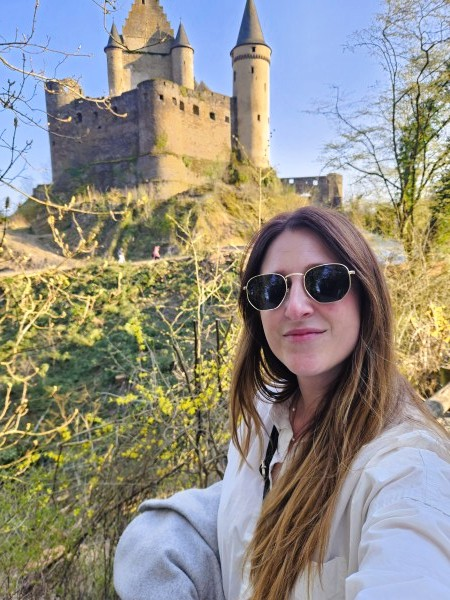
Vianden Castle sits high above the Our River. The medieval streets tumble down below it, and the whole scene is almost impossibly picturesque. The castle itself is one of the largest and best-preserved medieval fortresses in Europe. Its history stretches back to the 10th century, though most of what you see today dates from the 11th to 14th centuries. It fell into ruin over the following centuries before being purchased by the Grand Ducal family in 1977 and meticulously restored. Walk up through the town rather than taking the chairlift — the approach gives you the views gradually, which is far more satisfying. Inside, the Knights’ Hall, the chapel, and the residential rooms are all worth taking time with. The views from the ramparts over the valley are extraordinary.
Catch the bus back to Ettelbrück, then take the train to Luxembourg City.




Day 4: Echternach & the Mullerthal or the Moselle Valley
Option A: Echternach & the Mullerthal Trail
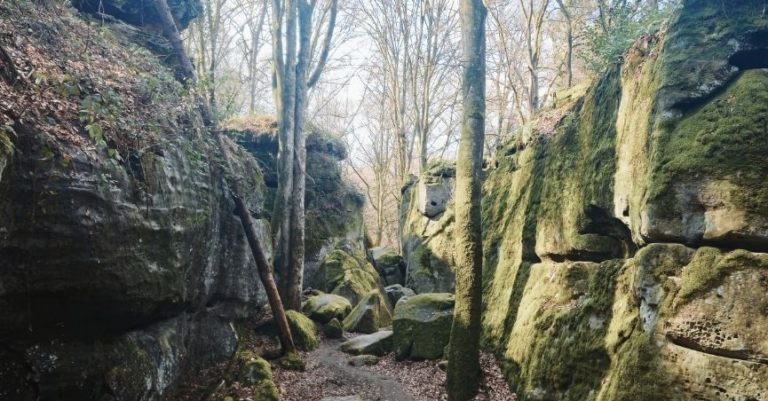
Echternach is Luxembourg’s oldest town, sitting on the Sure River on the German border, and it’s the gateway to the Mullerthal region — sometimes called Luxembourg’s Little Switzerland. This is walking country: narrow sandstone gorges, mossy boulders, forest paths that feel genuinely wild despite being well-marked and easily accessible.
The Mullerthal Trail covers around 112km in total, but the section closest to Echternach is the most dramatic and perfectly suited to a day hike – the E1 Loop. The trail winds through narrow rock passages, through forest, and out onto an open plateau with views across the Sure Valley. Wear proper shoes — sections are slippery when wet — and bring water and snacks. Most hikers complete a loop back to Echternach in four to five hours, depending on pace and stops.
Echternach itself is worth an hour or two before or after the hike — the Basilica of Saint Willibrord, the old town square, and the medieval abbey make for a pleasant wander.


Option B: The Moselle Valley
Luxembourg’s wine country runs along the Moselle River on the eastern border with Germany, and it produces wines that are far better than their international reputation suggests. The valley is small and easily explored in a day — either by car, by cycling along the well-maintained riverside path, or by a combination of train and local bus.
The main grape varieties to look for are Riesling, Pinot Gris, Auxerrois, and Pinot Noir, plus the outstanding Crémant de Luxembourg — the country’s sparkling wine, made using the traditional method and genuinely excellent value compared to Champagne.
Caves Bernard-Massard in Grevenmacher is one of the best places to understand Luxembourg wine properly. The guided cellar tour takes you through the sparkling wine production process — fascinating even if you’ve done winery tours before, because the scale of the chalk caves is spectacular — and finishes with a tasting. A thoroughly enjoyable couple of hours.
If you have more time, the Moselle villages — Remich, Wormeldange, Stadtbredimus — are all pleasant for a wander and a glass on a terrace. The riverside cycling path is flat, scenic, and about as close to a perfect afternoon as Luxembourg offers.


Final Thoughts
Luxembourg rewards the kind of traveller who arrives without enormous expectations and leaves slightly astonished. It’s an easy country to navigate — public transport is free, English is widely spoken, and the distances between everything are small enough that you’re never far from the next thing. But don’t let its size fool you into treating it as a quick stop. The history here is genuinely layered, the landscape is beautiful, and the food and wine are better than they get credit for.
Have you been to Luxembourg, or is it on your list? I’d love to know — drop your questions or recommendations in the comments below. And if you found this post helpful, save it for your trip planning.
Tour Ideas for Luxembourg
Pin me for later…

More Luxembourg & the Low Countries posts:
A Day Trip Cycling from Amsterdam to Haarlem
Mullerthal Trail Echternach Loop (E1): Day Hike in Luxembourg