A Day Trip Cycling from Amsterdam to Muiderslot Castle
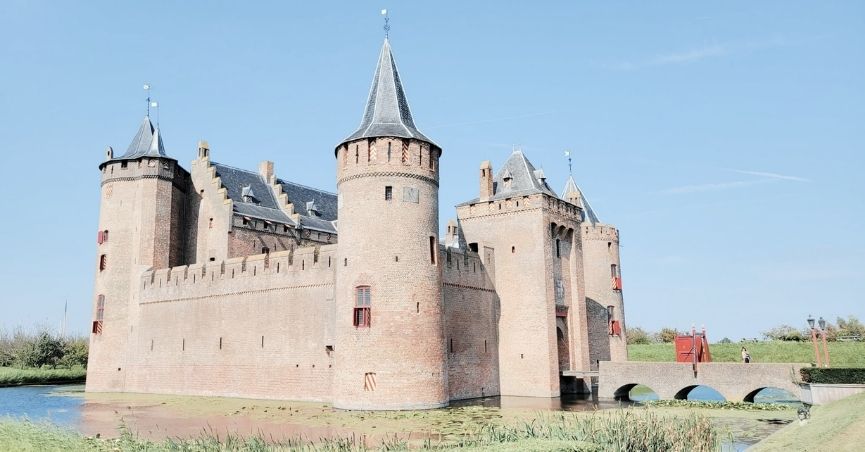
Rising proudly out of the Vecht River, Muiderslot Castle is one of the Netherlands’ most striking and well-preserved medieval fortresses. With its classic turrets, drawbridge, and moat, it looks like it’s been plucked straight from the pages of a fairytale.
As it is not far out of Amsterdam city center, this made for another perfect day trip – on bikes! The mostly flat route winds along the IJmeer Lake waterfront. This ride took us in a different direction than our trip out to Haarlem, offering more perspective on the nearby countryside. The ride took just over an hour each way, riding at a relaxed pace. We stopped for plenty of photos. This route is part of the Dutch national cycling network, so it’s well-marked and very bike-friendly. This post shares the biking route and a little about the castle visit.
Biking to Muiderslot Summary
- Distance: 40 km
- Total elevation: 162 m
- Type: out and back
- Surface: paved
- Bike lanes: at least 50% but likely more
A Brief Muiderslot History
Construction of Muiderslot started around 1280 by Count Floris V. At the time, this was an important waterway connecting the region to Utrecht. The castle was built to control and collect tolls from passing ships; its location was deliberately strategic. Muiderslot has served as a defensive stronghold, a residence, a cultural hub for poets, thinkers and playwrights, a prison and then the Netherlands’ first national museum.
The Route
This ride winds through the Gooi & Vecht region, a landscape that feels quintessentially Dutch from the moment you leave the city behind. The terrain is flat and water-rich, with canals, rivers, and drainage ditches running alongside much of the route. You’re almost always riding near water—sometimes directly beside it, other times catching glimpses through reeds and trees. The horizon stretches wide across open farmland, with quiet roads and long sightlines.

You pass through pockets of quiet wealth. Old estates and summer homes built during the Dutch Golden Age are often hidden behind hedges and gates.
Beyond the river, the route opens into classic Dutch polders. Low-lying farmland reclaimed from the water and carefully managed through canals and pumps. These stretches are simple but striking in their own way: wide skies, grazing cows, and narrow roads with little traffic. You may pass windmills or other waterworks, another reminder that this entire region is shaped as much by engineering as it is by nature.
You will pass Kustbatterij bij Diemerdam — Coastal Battery at Diemerdam, part of the Stelling van Amsterdam — the Defence Line of Amsterdam. This is now restored on the UNESCO list with a restaurant and event centre. The visitor centre pavilion has a beautiful spiral shape to it.
Getting closer to the castle, we passed Westbatterij Muiden, a 19th-century fortification. Originally thinking it was our destination, we were a little confused as it is now closed to the public, overgrown with greenery.


The Castle
The castle sits at the edge of the small town of Muiden, which is well worth wandering through after your visit. Most of the shops, restaurants, bakeries, and cafés line the waterside along the River Vecht, where you can stroll past boats and tall ships anchored in the harbour. It’s a quietly charming Dutch town — compact, unhurried, and effortlessly photogenic.
After locking up at the dedicated bike parking near the entrance, we crossed the drawbridge and spent a few hours exploring the castle grounds, exhibits, and surrounding gardens. Plan on two to three hours to take it all in without rushing.
The castle itself has been beautifully restored. After locking up at the dedicated bike parking near the entrance, we crossed the drawbridge over the moat and passed under the portcullis. Met with a cobbled central courtyard where we purchased tickets (19.50 euros), which included an audio guide.
From here, you can explore two routes: the Tower Route and the Knight’s Route. These take you through the armoury, the Knight’s Hall, and a series of rooms furnished to reflect life during the Dutch Golden Age. Highlights include climbing the round corner towers for sweeping views and visiting the Prince’s Room — named after Prince Maurits of Orange — set up with a curtained bed, fireplace, and the space where Hooft once hosted his literary circle.
Outside, the gardens are just as worthwhile. A 17th-century-style plum orchard and historic herb and vegetable gardens, once used by the castle kitchen, offer a quieter contrast to the interior spaces. From here, you’ll also get views over the harbour of Muiden and the former Zuiderzee.


The Return
We rode back mostly the same way, equally as scenic as the late afternoon sun was starting its golden hour glow. A stop we feel like we missed out on was Brouwerij ‘t IJ, which is attached to the de Gooyer windmill. Post-ride beers always hit the spot.
Definitely a contrast between the countryside bike paths and busy city streets, but the system is so well set up. It makes me hopeful that maybe one day, our system at home (Canada) will be half as integrated as this.
A visit to Muiderslot is an ideal day trip for anyone interested in Dutch history, architecture, or simply escaping the city for a dose of storybook charm.
Note on the Dutch Cycling Network
Cycling is the second-most common mode of transport in the Netherlands. 36% of Dutch people list the bicycle as their most frequent way of getting around on a typical day. In Amsterdam, that figure is closer to 38%.
The dedicated cycling network spans over 35,000 kilometres. Equivalent to a quarter of the Netherlands’ entire road network. Almost every street has a dedicated cycle path, lane, or shoulder, and the infrastructure is built around cyclists rather than as an afterthought.
Navigation is easy thanks to two main systems. The older system uses named long-distance routes called LF routes (Langeafstand Fietsroutes), while the newer numbered-node system — the knooppunten network — uses numbered junction points that you simply follow in sequence. Green and white signposts mark scenic cycling-only routes; red and white signs indicate shared routes with mopeds.
Pin me for later


Read these other Cycling Day Trip posts:
Or how about these other Netherlands posts:
A Day Trip Cycling from Amsterdam to Haarlem
Antwerp Itinerary: Things to Do & Places to Visit
A Day Trip to Bruges, Belgium from Ghent
4 Days in Luxembourg: Itinerary for First-Time Visitors