Climbing Kilimanjaro Lemosho Part II: Finding a Rhythm at Altitude
Days 4–6 of the Lemosho Route — where the mountain starts dictating the pace, the landscape turns prehistoric, and Karanga camp makes it all feel real.
Where we are in the climb
| Day | Section | Elevation | Distance |
|---|---|---|---|
| Day 4 | Shira 2 → Lava Tower → Baranco | 3,983 m / 13,066 ft | 10 km / 6 miles |
| Day 5 | Baranco → Great Baranco Wall → Karanga | 3,983 m / 13,066 ft | 5 km / 3 miles |
| Day 6 | Karanga → Barafu Base Camp | 4,673 m / 15,331 ft | 5 km / 3 miles |
By the middle days of climbing Kilimanjaro’s Lemosho route, life narrows down to its essentials: walk, eat, sleep, repeat. The rhythm is its own kind of meditation. You stop thinking about what you’d normally be doing at home, what emails are waiting, what’s happening on the other side of the world. The mountain becomes the whole world. And the mountain, in return, starts showing you things you couldn’t have imagined from the trailhead.
Day 4 – Shira 2 to Baranco
Elevation: 3,983 m/13,066 feet | Distance: 10km/6 miles | Time: 5 to 8 hours
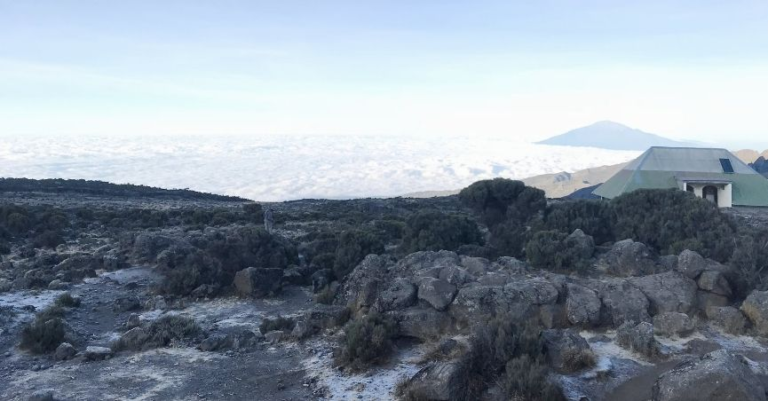
I woke up on Day 4 and stepped outside the tent into one of the most surreal views I have ever seen. It is still vivid — I think it always will be.
We were sitting above the clouds.
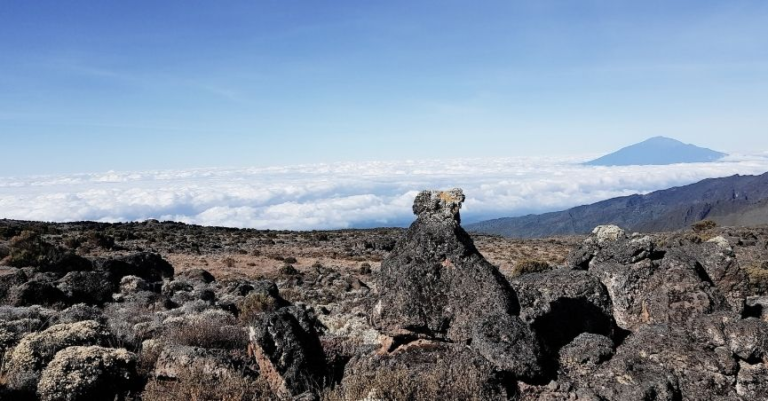
Not looking up at them. Above them. A solid white blanket stretched across the horizon in every direction, the shadows within it a soft, muted blue — the whole thing looking like piles of cotton batting or cotton candy, dense enough that you half-believed if you reached down and touched it, it would be soft and squishy rather than air. Only one other peak broke the horizon above the cloud line. Otherwise, it was just us, the sky, and the sense that we had somehow climbed to the top of the world.
It was the first moment the altitude truly registered as something other than a number on a trail profile. We weren’t just high. We were above the weather.
The day’s route took us up to the Lava Tower for lunch — a distinctive volcanic plug rising from the landscape at around 4,600 metres — and then back down into the Baranco Valley for camp. The descent after the tower is one of the Lemosho route’s acclimatization design features: gain altitude, then drop back down to sleep lower. Your body adjusts to the height without being asked to sleep at it. Pole pole — slowly slowly — applied not just to walking pace but to the whole approach.
The Plants
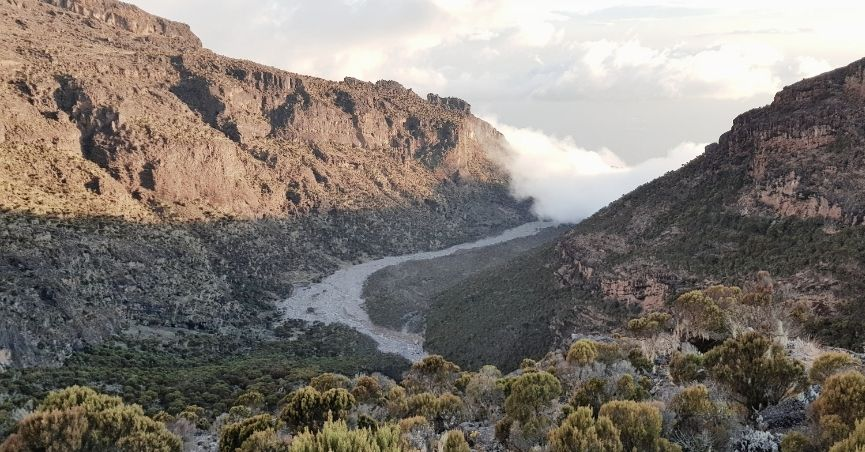
The Baranco Valley is where Kilimanjaro’s vegetation does something extraordinary.
Dendrosenecio kilimanjari — the giant groundsel, found only on the high slopes of Kilimanjaro — lines the valley in clusters that look like nothing else on Earth. Each plant consists of a thick trunk topped with a rosette of large, grey-green leaves, the whole thing reaching several metres high. Standing among them feels genuinely prehistoric — like stumbling into a Jurassic Park set that nobody told you about. They don’t look like something that belongs in the same world as the forest we’d walked through on Day 1.
We also saw giant lobelias (Lobelia deckenii), though at the stage we encountered them, they hadn’t yet fully bloomed — no tall central column yet, just the basal rosette. Looking down at them from above, the spiral pattern of the unfurling leaves was mesmerizing: the tightest, most vibrant green at the very centre, the leaves becoming looser and wider toward the edges, each one tipped with a reddish colour. Like a slow-motion uncoiling, frozen mid-movement.
The plants were a wonderful distraction on a long day. A reminder that altitude brings strangeness, and strangeness is worth paying attention to.
Baranco Camp
Baranco was my favourite camp of the entire climb.
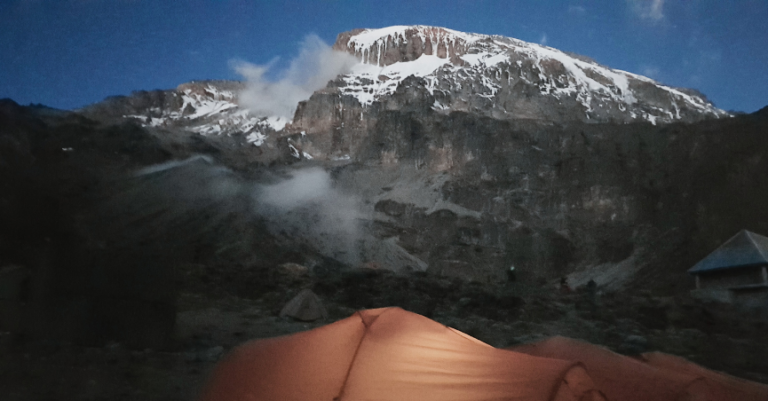
The setting is dramatic: a bowl-shaped valley with the Arrow Glacier high above on one side and the valley walls rising steeply on the others. We arrived to clear skies, which meant the full scope of the camp’s position was visible — and that night, a full moon rose and did something extraordinary to the glacier above us.
The ice glowed. A blue-silver light, cold and ethereal, the kind of light that doesn’t quite look real from a tent door. We had been spending evenings in the dining tent for warmth and for the group. By this point in the climb, the six of us had found our rhythm together, our camp routines established, the conversation easy in the way it gets when people have shared something difficult. That evening we lingered longer than usual, talking about the day and what was ahead, the Baranco Wall tomorrow and everything after.
Stepping outside the dining tent to look at the glacier in the moonlight was a moment I keep coming back to. The cliffs rising above the camp. The glacier catches the light. The particular quiet of being above the clouds at nearly 4,000 metres, with summit night still ahead.


Day 5 – Baranco to Karanga
Eleveation: 3,983 m/13,066 feet | Distance: 5 km/3 miles | Time: 4 to 5 hours
The Great Baranco Wall. You can see it from camp — a near-vertical cliff face rising from the valley floor, the trail climbing directly up it. It looks, from below, considerably more alarming than it turns out to be. It is also one of the best parts of the whole climb.
We pushed for an early start, wanting to be among the first groups on the wall before it got crowded. The scramble is single-file in the steeper sections, hands on rock, the exposure genuine enough to feel significant without being technically dangerous. The guides are excellent at this section — specific and calm, directing each move precisely:
Right hand here. Right foot here. Left hand here — now the left foot quickly, here — and swing up.
The first big manoeuvre was the most nerve-wracking, as firsts always are. After that, the rhythm of the wall took over. Hands, feet, move. The rock was solid, the guides knew exactly where to place me, and somewhere in the middle of it all, I noticed I was enjoying myself.
The porters, inevitably, were already somewhere above us. They take alternative routes up the wall — faster, steeper, less prescribed — carrying 15 kilograms on their backs, chatting among themselves and smiling as they went. There is no amount of time on Kilimanjaro that makes watching the porters work less humbling. They move through terrain that challenges us with a kind of relaxed efficiency that suggests the mountain is simply their commute.
We had good weather on the climbing side of the wall — clear, the views back into the Baranco Valley opening up behind us as we gained height. By the time we reached the top and crossed onto the other side, the fog had moved in. The Karanga Valley spread below us in grey and wind.
Karanga Camp — Where It Gets Real
Karanga is where the mountain stops pretending to be a hiking trip and announces itself as something bigger.
The camp sits on a genuine mountainside — sloped, rocky, minimal vegetation, the wind finding every gap in the tent fabric. Everything is at an angle: the tents, the paths between them, the short walk to the bathroom hut. That walk — maybe 50 metres, slightly uphill — was noticeably tiring. The altitude is working on you constantly now, even at rest.
This was the first night I felt properly on a big mountain expedition. Not a hike, not a trek. An expedition. The landscape said so clearly: no trees, no soil to speak of, rock and wind and the thin air that makes every small effort a conscious one.
Sleeping on a slope has its own particular quality. You drift toward the tent’s lower end through the night, wake up slightly scrunched, and spend the first few minutes of consciousness reminding yourself where you are. Summit night is tomorrow — or more precisely, it starts at midnight tonight, technically making it Day 7 before it ends. The distinction between days has been blurring since Baranco.


Day 6 – Karanga to Barafu High Camp (base camp)
Elevation: 4,645 m/15,239 feet | Distance: 5 km/3 miles | Time: 4 to 5 hours
The short walk from Karanga to Barafu is the calm before the storm. The route climbs steadily across open, rocky terrain with the mountain’s upper slopes now clearly visible — the Kibo crater rim above, the Rebmann Glacier to the east. The altitude is tangible now in a way that’s difficult to describe to someone who hasn’t felt it: the air is thin enough that you’re aware of your breathing in a way you normally aren’t, aware of each step as a small expenditure of energy that adds up faster than it should.
Barafu Base Camp sits at 4,673 metres — the last camp before the summit push. It’s exposed, rocky, and considerably less picturesque than Baranco. That’s fine. You’re not here for the scenery. You’re here to eat, rest, check your gear, and try to sleep for a few hours before the 11 pm or midnight start that will take you — if the mountain and your body cooperate — to the roof of Africa by sunrise.
The guides brief the group after dinner: layers, pace, signs of altitude sickness, and what to do if someone needs to turn back. The headlamps are charged. The warmest layers are laid out. The summit is close enough to feel real now.
Try to sleep. You won’t entirely. That’s normal.


What These Middle Days Teach You
By the end of Day 6, the climb has done something to you that’s hard to articulate until after you’re home and looking back.
The middle days strip away the noise. There’s no phone signal, no work, no obligations beyond the one immediate thing: keep moving, pole pole, up the mountain. The simplicity is its own kind of relief. You find out what you’re made of not in the dramatic summit moment but in the accumulated small choices of the middle days — getting up when it’s cold, keeping moving when your legs are tired, choosing to look at the plants rather than watch your feet, stepping outside the tent to see the glacier in the moonlight rather than staying warm inside.
The mountain gives you exactly what you bring to it. Bring curiosity, and it rewards you with prehistoric plants and cotton candy clouds. Bring patience, and the acclimatization days feel like gifts rather than delays.
Have good boots. Obviously.
Practical Notes for Days 4–6
The Lava Tower acclimatization day is genuinely useful — resist the urge to skip it or treat it as a rest day. The climb to 4,600m and descent to 3,983m for sleeping is doing important work in your bloodstream.
The Great Baranco Wall is less technical than it looks from camp, but more physical than a standard trail section. Let your guide direct your hands and feet, move slowly, and don’t look down more than you need to. Allow 1.5–2 hours for the wall section specifically.
Watch for altitude symptoms from Day 4 onward — headache, nausea, loss of appetite, disrupted sleep. Mild symptoms are common and manageable; persistent or worsening symptoms should be reported to your guide immediately. The acclimatisation profile of the Lemosho route is specifically designed to reduce risk, but no profile eliminates it entirely.
Sleep at Karanga as best you can. The slope is annoying. The altitude disrupts sleep. Do it anyway — you need whatever rest you can get before Barafu and the summit push.
Eat at Barafu even if you’re not hungry. Summit night is 7–8 hours of continuous effort in very cold conditions, starting at midnight. The calories matter.
Continue to Part III: Summit Night →
Pin me for later…

Other posts in this Mount Kilimanjaro Series:
Mount Kilimanjaro Lemosho Route Part I: Getting to the Mountain
Mount Kilimanjaro Lemosho Part III: Summit Night