Visiting Sintra Portugal: So Much More Than a Day Trip from Lisbon
When I first started planning my Portugal trip, Sintra kept appearing in every guide as a recommended day trip from Lisbon — 40 minutes by train, see the palaces, back for dinner. Most people do it that way. We decided to stay two nights instead. It’s one of the better travel decisions I’ve made.
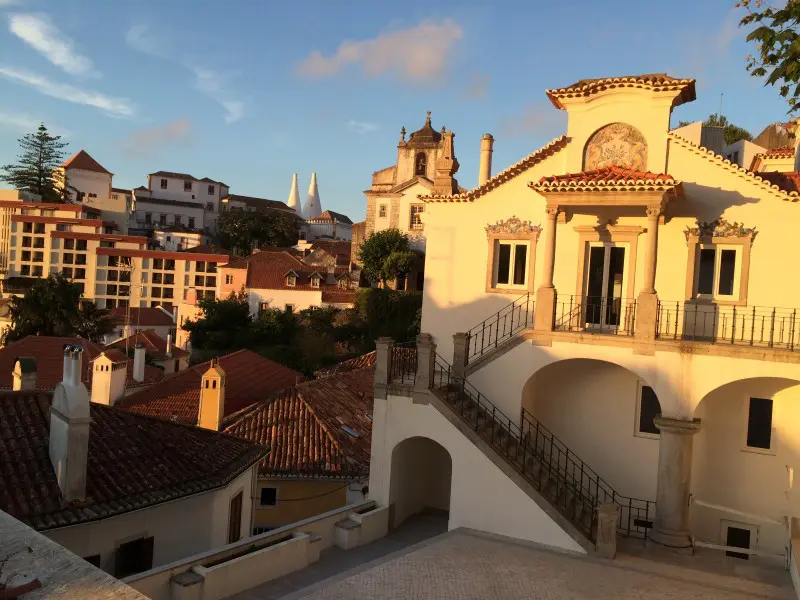
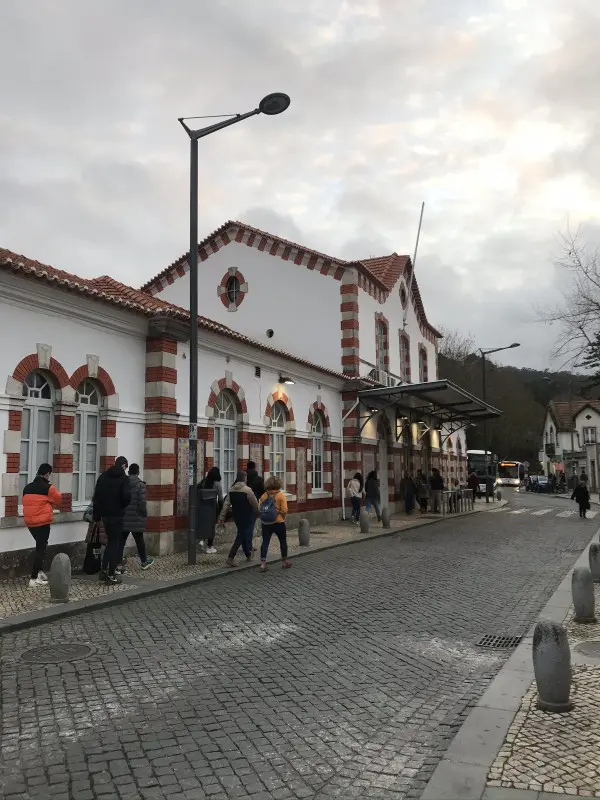
The Sintra Portugal day trip is perfectly doable. But what you gain by staying overnight isn’t just extra hours — it’s a completely different experience of the place. By early evening, once the day-trippers have caught their return trains to Lisbon, the streets empty out. The sounds shift from tourist chatter to restaurant conversation, birdsong, the occasional car. The evening streetlights make the old buildings glow. The palaces are closed, but the town is entirely yours, and Sintra after dark has a quiet, slightly mysterious atmosphere that the daytime crowds don’t allow for.
Stay at least two nights. You won’t regret it.
Sintra Portugal Summary
Location: western Portugal, located about 25–30 km northwest of Lisbon
Recommended stay: 2 nights minimum, but many do as a day trip
Top sights: Pena Palace, Quinta da Regaleira, Moorish Castle, Monserrate
Getting there: Train from Lisbon Rossio station — free with Lisboa Card
Book ahead: Pena Palace and Quinta da Regaleira get very busy — book tickets online
What Makes Sintra Different
There’s an observation that keeps coming back to me about Sintra: moving between its palaces feels a little like moving between themed sections of a theme park. Each one has its own distinct character, its own architectural language, its own atmosphere — from the vivid Romanticist fantasy of Pena to the mystical symbolism of Quinta da Regaleira to the serene Indo-Moorish elegance of Monserrate.
The difference, of course, is that none of it is manufactured. These are real places built by real people — monarchs, aristocrats, enormously wealthy eccentrics — each one trying to express something about their status, their connections, their taste, or their desire to be uniquely themselves. Palaces are inherently over the top. That’s the point of a palace. In Sintra, that quality is concentrated across multiple estates on the same forested hillside, each one a different expression of the same fundamental impulse: look what I built.
What makes it remarkable rather than exhausting is the setting. Sintra’s Serra has its own microclimate — cooler, greener, and often damper than Lisbon even in summer. The forests feel genuinely lush in a way that the rest of Portugal doesn’t. The gardens around each palace range from formally manicured to deliberately wild, with secret paths and hidden corners built in by design. The combination of architecture and nature — finery and forest — is what gives Sintra its particular magic.

Suggested Sintra Itinerary
Day 1: Pena Palace, Pena Park & the Moorish Castle
Start with bus 434 from Sintra town — it climbs to the palaces at the top of the Serra and saves you a very steep hour-long walk uphill in the heat.
Pena Palace & Park
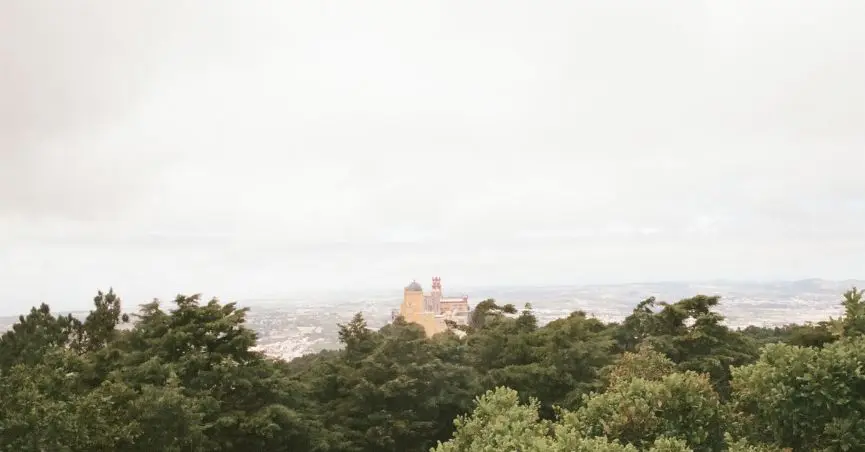
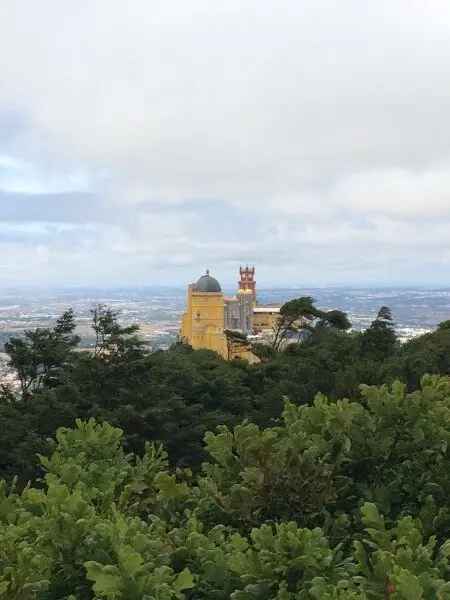
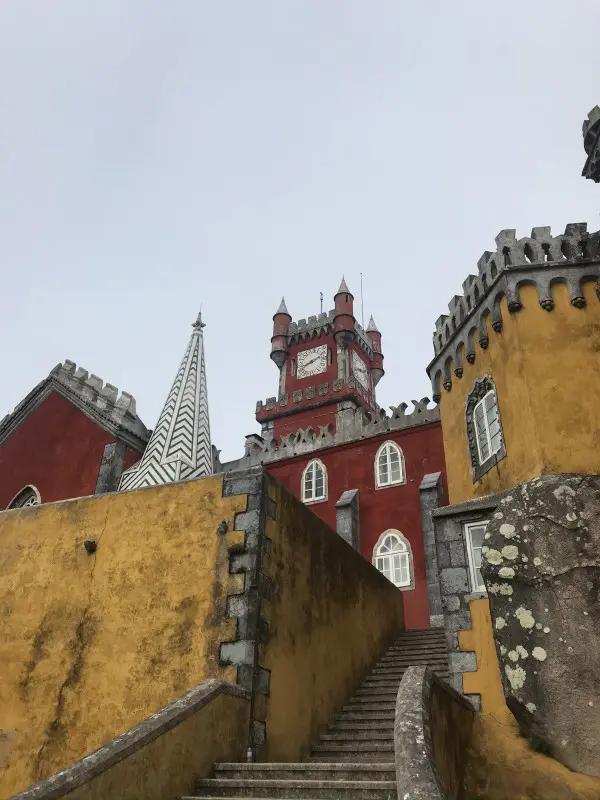
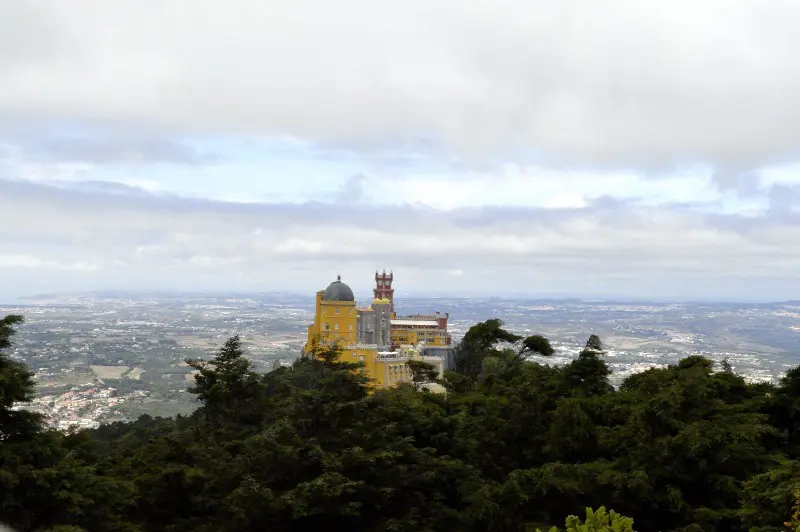
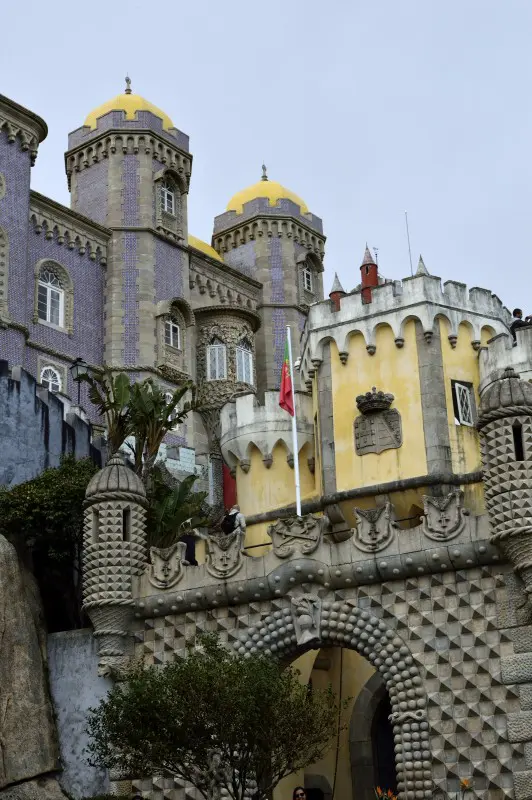
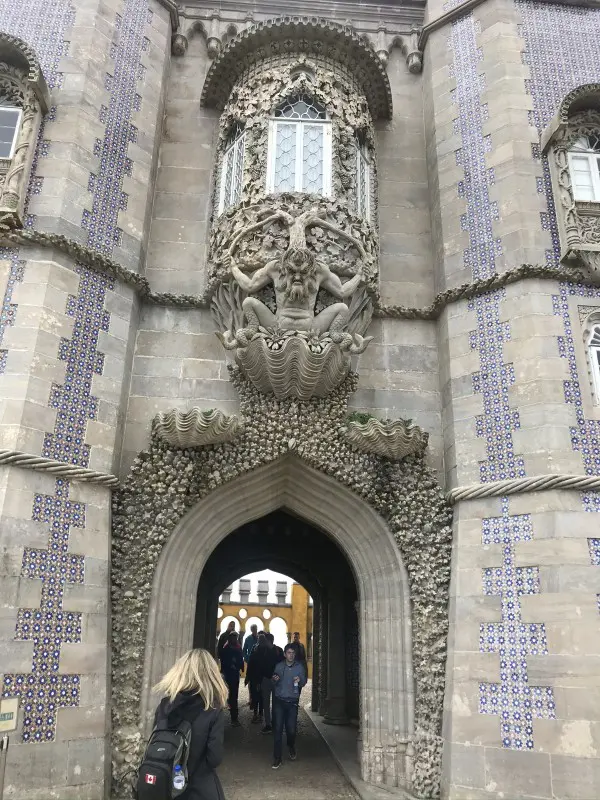
Pena Palace is the crown jewel, and it earns the description. Perched on a hilltop, visible from miles away, it’s an explosion of colour — red and yellow towers, ornate domes, elaborate stonework, the whole thing built in the 19th century as a Romanticist fantasy on the ruins of a former monastery. The architectural styles are deliberately mixed — Gothic, Moorish, Manueline — layered together into something that shouldn’t work and somehow does completely.
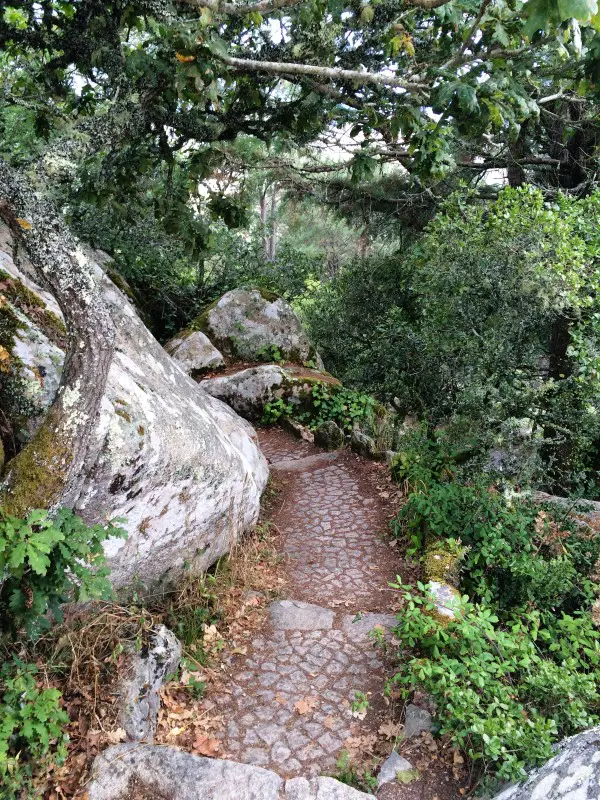
The Pena Park surrounding the palace is vast and worth exploring first if the ticket queue at the palace itself is long. The park has its own microclimate — cooler and greener than you’d expect, with tropical trees and non-native species alongside the native forest, hidden pavilions tucked into the hillside, and a slightly otherworldly quality that the palace above only amplifies.
Castelo dos Mouros
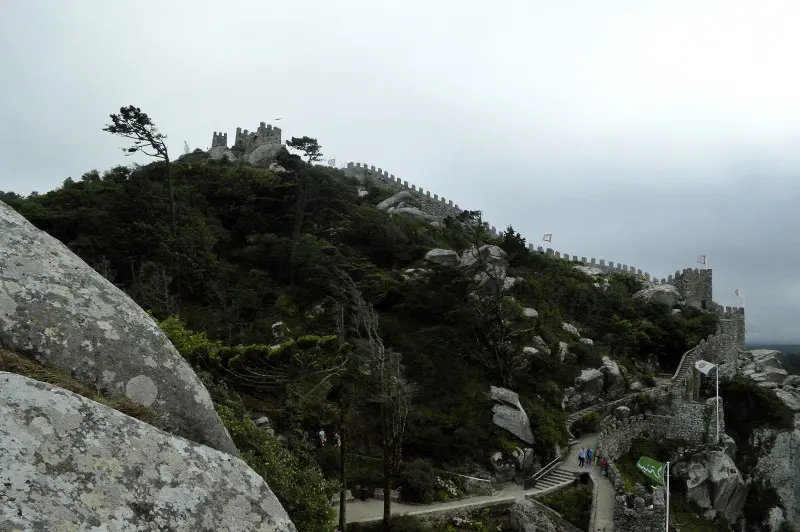
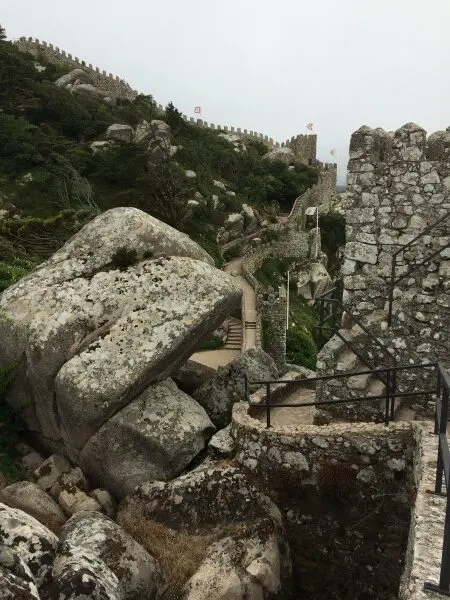
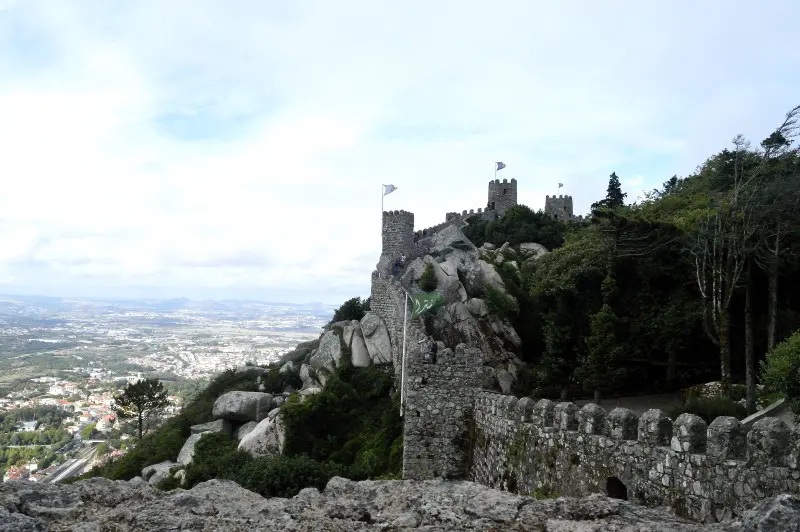
The Moorish Castle sits a short walk from Pena along the ridge — older, rougher, and a completely different experience from the polished palaces. Built in the 8th and 9th centuries, the castle’s walls follow the natural line of the ridge and the walking paths teeter close to the cliff edge, the rocky drop visible below. The gusts of wind that roll across the exposed ramparts add to the drama. By the time we reached the top, clouds had rolled in quickly — the air cooler and heavier, a dampness that wasn’t there at the base — and the panoramic views across Sintra’s forests toward the Atlantic had taken on a slightly theatrical quality, the mist moving through the trees below.
It’s less polished than Pena or Monserrate. It has considerably more character.
Don’t look straight down if heights make you nervous. The views are better sideways anyway.
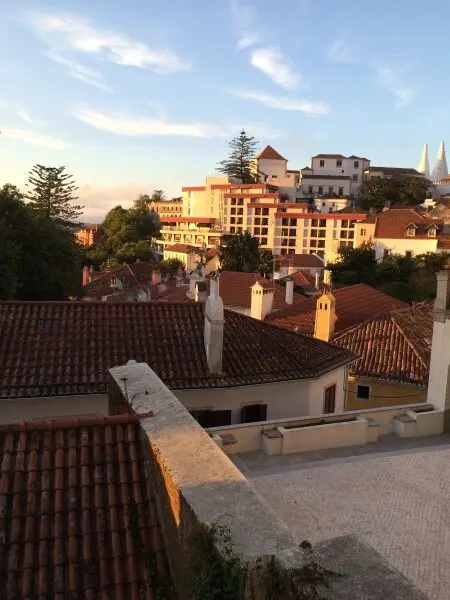
Spend the afternoon and evening in Sintra town. Visit the National Palace — recognizable by the two enormous conical chimneys rising above the town centre — before the day-trippers leave and the place becomes yours.
Day 2: Quinta da Regaleira & Monserrate
Quinta da Regaleira
Visit at opening or near closing to beat the crowds.
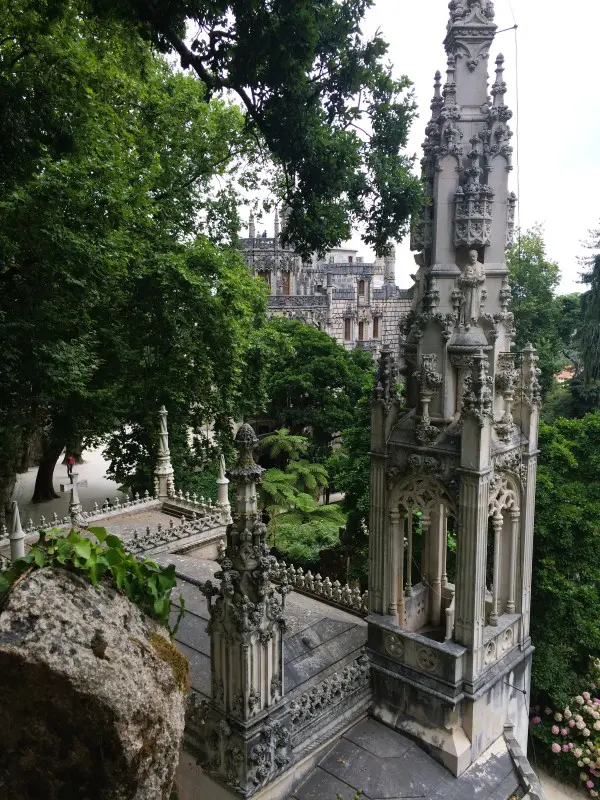
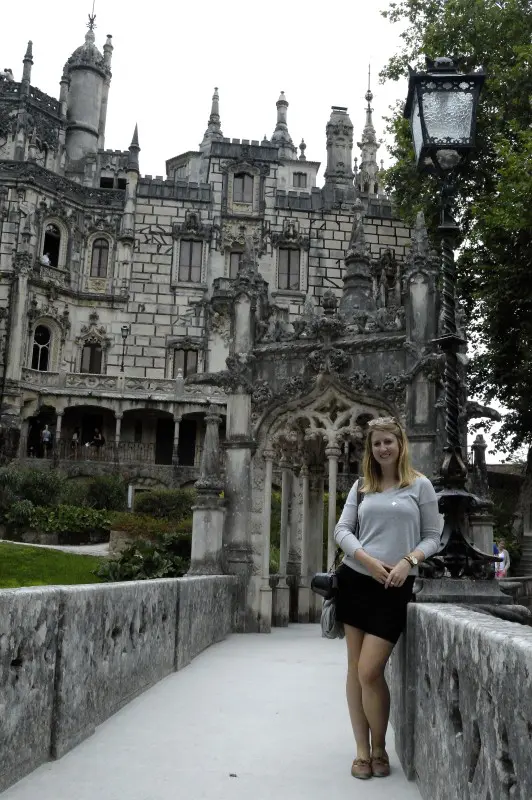
This Gothic-style estate was our favourite stop in Sintra, and it’s not a close contest. Built by one of Portugal’s wealthiest men at the turn of the 20th century, the mansion itself is ornate and fascinating — but it’s the gardens that make it something else entirely. Winding stone staircases, secret tunnels, grottoes, fountains, hidden chapels tucked into the hillside. The whole estate is saturated with symbolism drawn from alchemy, Freemasonry, and Rosicrucian mythology — which makes it feel less like a garden and more like a coded message, if you knew how to read it.
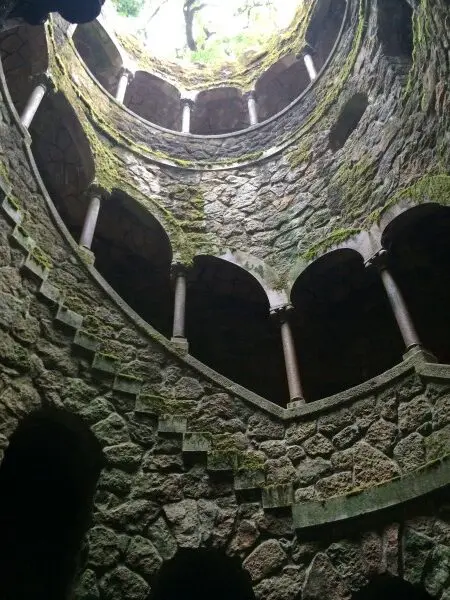
The Initiation Well is the centrepiece. It descends underground in a spiral, with arched openings at each level looking into the central shaft. As you descend, your perspective continuously shifts — what started as looking down toward a tiled floor gradually becomes looking up toward the opening above, tree branches and sky visible at the top, the air getting cooler and damper the deeper you go. I didn’t fully register how far down I’d gone until I looked up and realized how small the opening at the top had become. It is genuinely one of the most unusual spaces I’ve been in — not dramatic in a scary way, but quietly, persistently strange.
Palácio de Monserrate
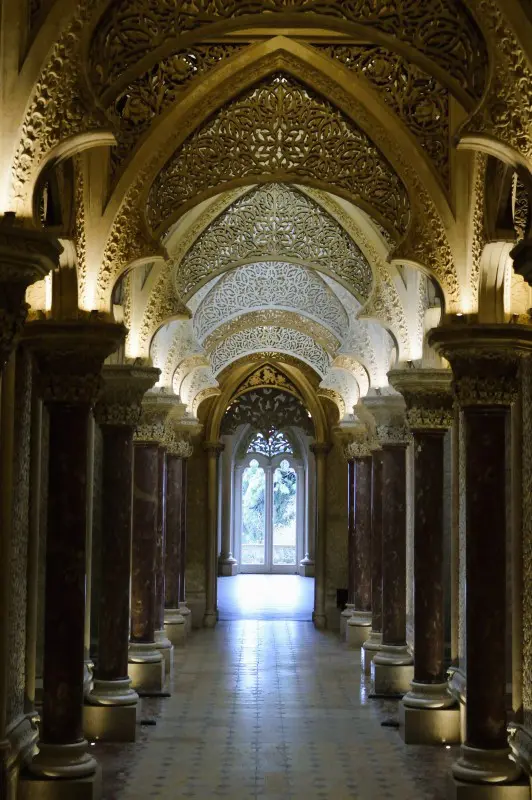
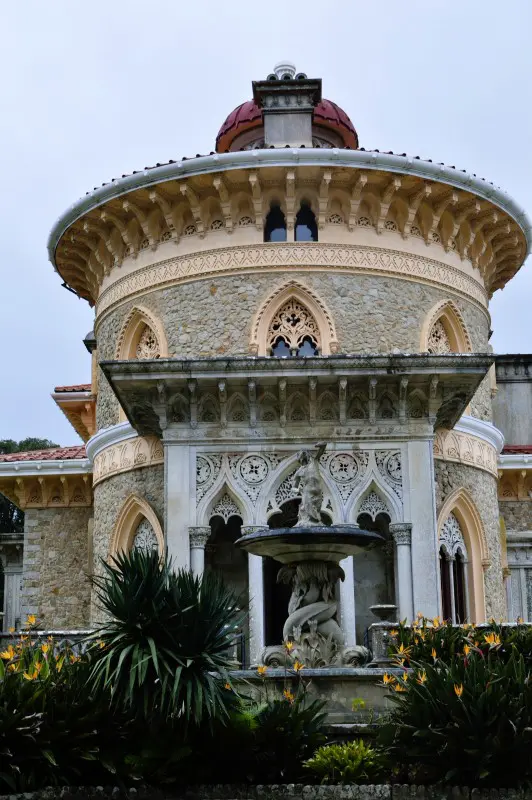
Requires a car or taxi — it sits further from the centre than the other palaces, which is exactly why it’s quieter. The palace is a stunning 19th-century confection of Gothic, Moorish, and Indian architecture: domes, arches, intricate carved details, a building that manages to be simultaneously unfamiliar and entirely at home in its Portuguese hillside setting.
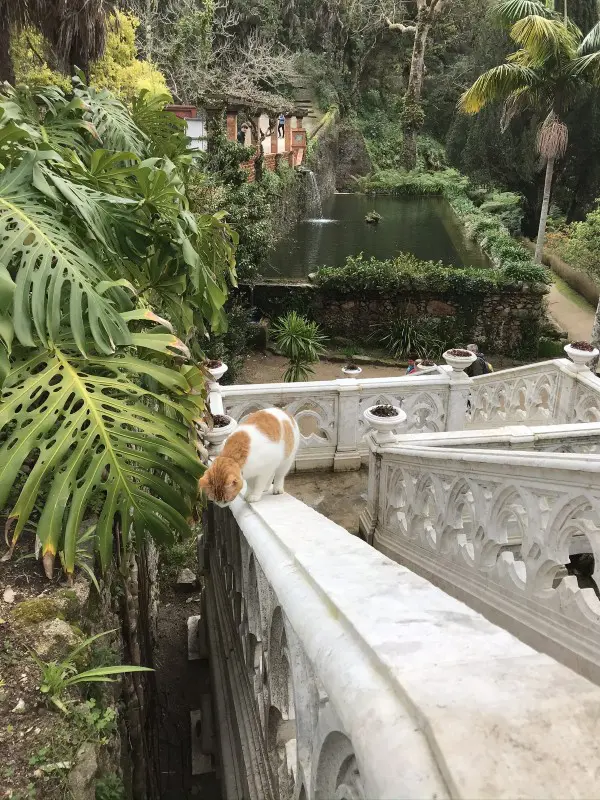
The surrounding park is the real pleasure — designed around different landscape themes, from succulent gardens to lush English-style lawns, with streams running through and hidden pathways that reward wandering without a map. It’s a place for slowing down: spreading out on the grass, following a path to see where it leads, watching light change across the formal gardens. The intimacy of the scale, compared to Pena, makes it feel like a discovery rather than a destination.
Day 3: Nearby Sights Worth Adding
If you have a third day or want to venture beyond the main palaces:
Convento dos Capuchos — a 16th-century Franciscan monastery built into the rocks deep in the forest. The monks carved their cells directly into the hillside and lined the low doorways with cork for insulation. It’s small, atmospheric, and completely unlike anything else in Sintra.
Palácio Nacional de Sintra — the twin chimneys are visible from everywhere in town. The interior is one of Portugal’s best-preserved medieval royal palaces.
Praia das Maçãs by tram — the historic Sintra tram runs from the town to the Atlantic coast at Praia das Maçãs. Take it for the journey as much as the destination.
Cabo da Roca — the westernmost point of mainland Europe, 140 metres above the Atlantic. Combined with a bus to Cascais (either a 30-minute direct ride or a scenic 60-minute coastal route via Cabo da Roca), it makes a full day along Portugal’s western edge.
Practical Notes
Getting to Sintra from Lisbon: Train from Lisbon Rossio station — approximately 40 minutes, departures every 15–20 minutes. Free with the Lisboa Card. Sintra station is a short walk from the town centre.
Getting around Sintra: Bus 434 covers Pena Palace, Pena Park, and the Moorish Castle. Bus 435 reaches Quinta da Regaleira and Monserrate. Both run from the town centre. Tuk-tuks and taxis are available for those who prefer more flexibility.
Book tickets in advance. Pena Palace and Quinta da Regaleira both get very crowded, and tickets can sell out. Book online at parquesdesintra.pt before your visit — particularly in summer and on weekends.
When to visit Sintra is beautiful year-round. Summer is busiest — arriving early and staying overnight mitigates the crowds significantly. Shoulder season (March–May, September–October) offers cooler temperatures and more manageable visitor numbers. The microclimate means even a warm day in Lisbon can feel cool and overcast on the Serra — bring a layer regardless of season.
Stay overnight: Two nights is ideal. The first evening after day-trippers leave, and the early morning before they arrive the next day, are the two best times to experience Sintra — and you only get both if you stay.
Final Thoughts
Sintra is whimsical, mysterious, and steeped in history—from its Moorish roots to its Christian palaces and extravagant architecture. Staying overnight lets us slow down and really take in the magic, rather than cramming it all into a hectic few hours. Next time I’m in Portugal, Sintra will be on the list again—no question—and I’ll be booking at least a couple of nights.
Share in the comments your favourite parts of Sintra!
Pin me for later


You might also enjoy…