
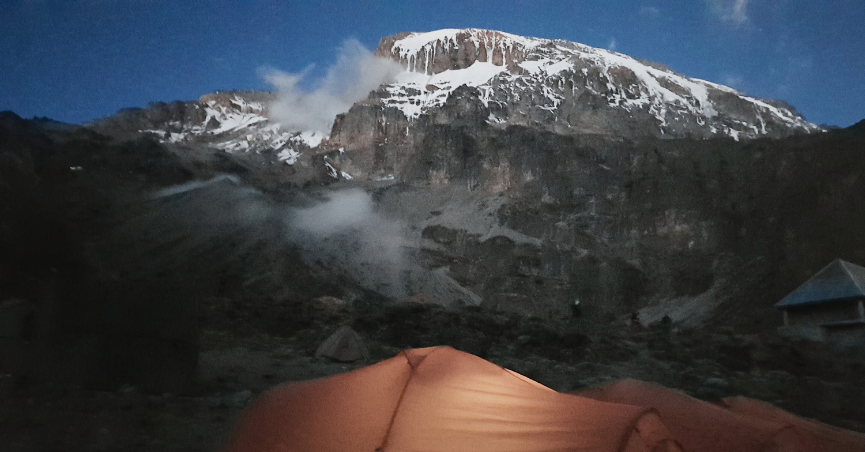
Summit night is often described as the hardest part of climbing Kilimanjaro — and for good reason. Cold, wind, exhaustion, altitude, and doubt converge in the dark hours before dawn. This final section covers the long night to Uhuru Peak and the quiet emotional comedown afterward.
Day 6 – Barafu to Uhuru Peak to Mweka Camp
Elevation: 5895 m/19340 ft | Distance: 5 km/3 miles ascent + 12 km/7 miles descent | Time: 10-16 hours
Prepping for summit
Wind ripped through the camp starting late in the afternoon and continuing through the night. It was hard to get solid sleep between the wind howling, the tent flapping and the nerves. Oh, also, it was snowing. We put on so many layers. I could hardly move; I felt like the Michelin Man. We had a pre-summit snack of coffee (with butter) and cookies. Filled our camelbacks with near-boiling water (so it didn’t freeze). Off we went in the wind and snow.
Summiting Mount Kilimanjaro Lemosho
We had booked the full moon tour, hoping for decent light during our nighttime summit, but instead, we walked by the light of headlamps. It was actually a really cool sight, little blobs of light bobbing along in a row ahead of you – a foreshadowing of the route to come – but also behind you, showing how far you have already gone. At this point, my body weight (and the layers) alone made me tired. Did I mention by this point I think my cold had turned into pneumonia? Or that I was wondering what the heck I had gotten myself into?
Camp to Stella Point
Barafu to Stella Point is the hardest part. Constant incline, switchbacks and increasing altitude. Dizziness hit me fast and hard. We continued at a steady but slow pace, only stopping when absolutely necessary – it was too cold to linger. I was saying “right foot, left foot” over and over in my brain for a long stretch. Much of it is a blur. I definitely had acute mountain sickness – likely due to also having a respiratory infection of some sort. The guides did not want to test my oxygen levels because if they had a low reading, I would be forced to descend. But they were keeping a very close eye on me.
Uhuru Peak
The walk from Stella Point to Uhuru Peak seemed unending, possibly because it was just white nothingness around us. Eventually, we saw others coming back toward us with huge smiles on their faces. This gave us renewed energy and purpose. Once you get to Uhuru, you have a few minutes to savour your accomplishment and take a few photos. The air is thin, and there are lots of people behind you waiting for their turn. I was obviously quite unwell, staggering a bit. Our guide decided we couldn’t take the same route back – I needed to get to a lower elevation. We separated from our group and basically slid down the mountain on a gravel path. It was kind of fun, and I was immediately feeling better. 7 hours climbing up and 2.5 hours sliding down.


Post-Summit
You get a proper breakfast back at camp and a few hours to rest. But then by midday it’s lunch and back down the mountain. Down is fast, even though you are mentally and physically exhausted. The landscape changes dramatically from desolate to seeing plant life again to lush forest. It started to rain, hard, halfway to the next camp, but at this point, everyone was mission-focused. We had done the big thing, now we wanted rest.
Day 7 – Mweka Camp to Moshi
Elevation: 3068m/10,065 feet | Distance: 10 km/6 miles | Time: 3 to 4 hours
Still raining, no one daudled, and we were on the trail shortly after breakfast. I think we were all ready for a hot shower, a proper bed and no more trekking. Seeing the sign for Mweka Gate was when the sense of accomplishment really hit. I did it. I climbed Kilimanjaro, the tallest mountain in Africa, the world’s tallest free-standing mountain.
That evening after showers and naps, we had a farewell dinner with our guides, porters and fellow climbers. We were given our certificates and T-shirts. The emotions were high for everyone.


Mount Kilimanjaro Lemosho Tips (Part 3)
Making It to Summit
- Wear all your layers – expect to be cold (snow or not).
- Carry as little as possible.
- Eat before you start, even if you don’t want to.
- Go slow.
- Communicate with your guides.
- Find a mental tactic to keep going.
- Once you reach Stella Point, know that the hardest part is over.
Final Reflection
Not to sound dramatic, but this trek changed a lot of things for me. I had shaped a new level of mental toughness I didn’t know I had before. I pushed my body through physical exhaustion, soreness and more. This trek showed me the allure of “type 2 fun.” It gave me a healthy appreciation for the fact that I can do hard things, but also to appreciate the fact that it is a hard thing! Do I wish I had done a bit more training beforehand? Yes. Do I wish I weren’t sick so I could remember more of the summit night? Yes. Would I change anything? No.
Pin me for later…

Other posts in this Mount Kilimanjaro Series:

Mount Kilimanjaro Lemosho Route Part I: Getting to the Mountain

Climbing Kilimanjaro Lemosho Part II: Finding a Rhythm at Altitude
More Tanzania posts:



Leave a Reply