
On the west bank of the Nile, across from modern-day Luxor, lies one of the most awe-inspiring archaeological regions in the world: the Theban Necropolis. I hadn’t heard the term before this trip, but once we arrived, I quickly realized just how significant—and surreal—this area is. The Necropolis is a sprawling landscape of tombs, mortuary temples, and ancient ruins, built to honour pharaohs, queens, nobles, and workers of Egypt’s New Kingdom. Egypt’s New Kingdom (c. 1550–1070 BCE) was one of the most powerful and prosperous periods in ancient Egyptian history. Often called the “Golden Age” of ancient Egypt, this period marked a time of strong centralized rule, military expansion, monumental architecture, and cultural flourishing.
Every stop on the Necropolis left us speechless. It’s hard to grasp the scale until you’re standing in the desert heat, staring up at stone colossi or descending into elaborately painted tombs carved deep into the rock.
How to get to the Theban Necropolis
As you can see, everything is pretty close together on the map, which means you can bundle all these sights in one day. However, you will still want a car – either driving yourself or with a driver/guide. The air conditioning is a nice reprieve too!
We started our day at the Valley of the Kings (post here). You might think going into tombs during the hottest part of the day makes sense – underground, shady – but it’s not. The tombs are stifling – hot with stagnant air. Plus all the visitors.
Go in the morning and save the open air spaces of the Theban Necropolis for the afternoon.

Sights of the Theban Necropolis
Valley of the Nobles
Though not nearly as rich and detailed as the pharaoh’s tombs, the nobles’ tombs have great examples of everyday life. While the royal tombs were hidden away in an isolated valley, the Tombs of the Nobles were dug in the mountain overlooking the River Nile.
The Valley of the Nobles includes nearly 500 tombs of Theban nobles and high officials. Some tombs of note are: Sennefer, a mayor of Thebes, and Rekhmira.
Sennefer’s tomb is one of the most beautiful and best-preserved burial chambers in the area. The walls and the ceilings of the tomb contain many colourful scenes of family life and Sennefer’s work as mayor.
Deir El Medina
Also known as the workers’ village, Deir el-Medina is located just south of the Valley of the Kings. This village was once home to the people employed to build the great tombs in the Valley of the Kings.
The discovery of Deir el-Medina is considered to be one of the most unique and groundbreaking discoveries ever made in Egypt. With its discovery came a new understanding of typical community living during the time of the pharaohs.


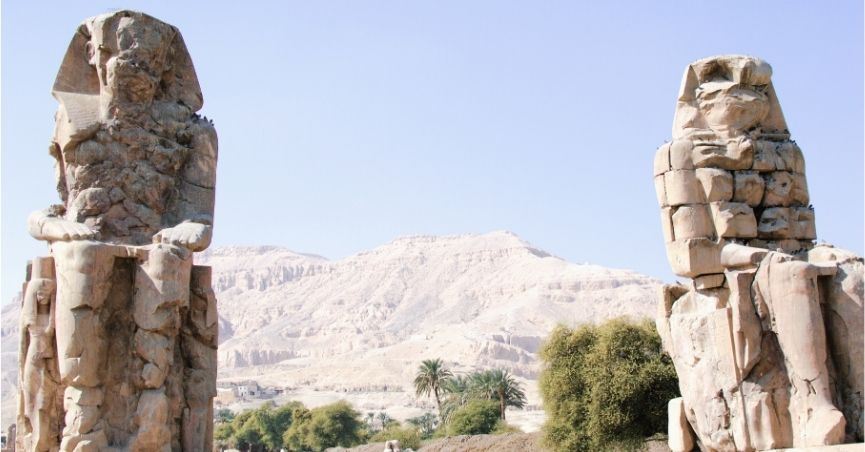
Colossus of Memnon
The only remains of Amenhotep III’s huge mortuary temple complex are the two giant statues, standing at 23 meters tall. Historians believe that this temple complex, if it were still standing, would be larger and more impressive than Karnak.
It is free to visit the Colossi, and only really needs a quick stop for some photos. Guidebooks recommend visiting at sunrise for beautiful lighting and fewer people.

Queen Hatshepsut’s Temple
An ancient mortuary temple to one of the few female pharaohs, Hatshepsut. The temple is considered an engineering marvel, much like many of her other building projects. This temple is important because it offers insight into Hatshepsut’s rule. Unfortunately, she was largely written out of history by her stepson, despite her rule being a time of stability, prosperity and impressive architecture. Fortunately, the stories told on the colonnades in the temple shed light on the two decades of her reign.


Medinet Habu
The site of Medinet Habu covers a large area with temples, shrines, and administrative buildings spanning centuries of use. It is located across the Nile from modern-day Luxor. The highlight of the complex is the mortuary temple for Ramesses III. Its walls are covered in incredibly vivid and detailed reliefs that show both religious rituals and dramatic battle scenes. It is one of the best-preserved temples of this time.


Pin this for later…






Leave a Reply