
By the third day of climbing Kilimanjaro Lemosho route, life narrows down to the essentials: walk, eat, sleep, repeat. This middle section of the climb is where acclimatization becomes real, distances feel deceptive, and the mountain begins to dictate the pace rather than you.
Day 4 – Shira 2 to Baranco
Elevation: 3,983 m/13,066 feet | Distance: 10km/6 miles | Time: 5 to 8 hours
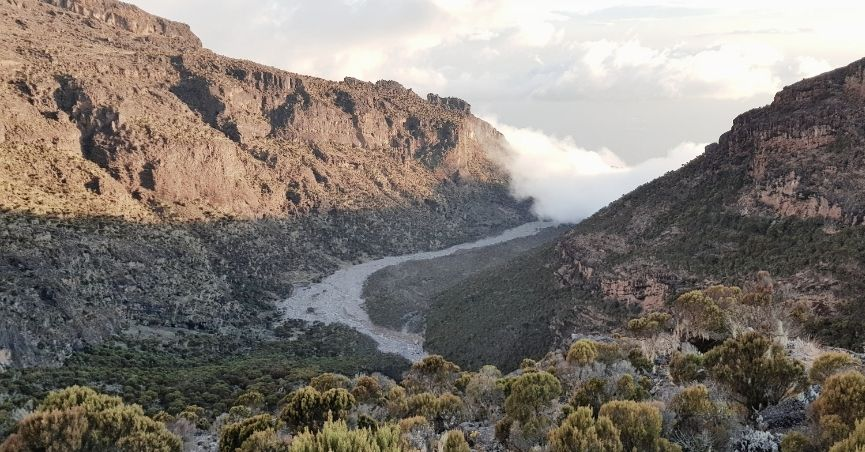
Again, waking up to a completely different view this morning. I think it is one of my favourite ones ever, and it is still so vivid in my memories. We were sitting above a cloud blanket. It really hit home how high we’d climbed. Today was a “medium” day, not too much distance, some elevation gain, but returning to similar elevation for aclimatization. It was uphill to the Lava Tower, where we had lunch, but then downhill into a valley for camp Baranco. There were so many interesting plants here, I was fascinated by them all. A good distraction! I was starting to get a better internal calibration of the distances. I definitely preferred the medium-distance day! Despite the views in the morning, Baranco was my favourite camp of all. It had views of Arrow Glacier towering above us, and we were lucky enough to have a clear sky and a full moon.


Day 5 – Baranco to Karanga
Eleveation: 3,983 m/13,066 feet | Distance: 5 km/3 miles | Time: 4 to 5 hours
This was a really fun day. Usually, you can kind of see where the trail goes, especially when other groups are in front of you. We planned to leave very early and be one of the first groups out. Soon, we understood the push. We were going up over the valley’s cliff to another valley on the other side. This is a famous part of the trail, the Great Baranco Wall. It definitely looked intimidating – but it was fun and a great way to break up the walking. There were some technical movements, scrambling and holding onto the rock face, but we went single file and pole-pole. Of course, the porters flew past us, scrambling up side routes like mountain goats with 15 kilograms on their backs. They are truly amazing. The day started sunny, but by the time we reached the top, it was socked in, foggy, windy and a bit colder. The weather continued like this to the Karanga camp. Karanga really made us feel like we were on the mountain. Everything was on a slope, even the tents. But this is where our bags arrived. Porters took a different route up the mountain to bring us our gear and take our rented gear down. I was so grateful to have my own clothes for the last part of the trek – the colder and harder sections.


Day 6 – Karanga to Barafu High Camp (base camp)
Elevation: 4,645 m/15,239 feet | Distance: 5 km/3 miles | Time: 4 to 5 hours
This was a “short” walking day, maybe distance-wise, but certainly not easy, as it is mostly uphill. The elevation changes became even more evident, I started breathing heavier sooner, and it all felt like it took more energy to walk. That’s just it, too; we were walking, not really hiking. The air was colder, the landscape was pretty desolate, maybe like the moon. All grey dirt and scattered rocks, scarce plantlife and definitely no wildlife. You can see Barafu in the distance, but like always, distances are deceiving, and the destination is always farther than you think. There are many ups and downs before reaching camp, many of which are similar to the incline grade up to Stella Point on summit night. Once at camp, we had lunch. Then the guides took us on an optional (though not really) acclimatization walk. You walk part of the summit night route, so it is also like a scouting mission, which I found very valuable in my mental preparation. The rest of the day is for resting and eating, as the summit walk starts at midnight.


Climbing Kilimanjaro Lemosho Tips (Part 2)
Your Team
- Guides are highly trained professionals having completed years of schooling and practical exams. When they give advice — listen.
- Porters are an essential part of the team, carrying everything needed for the climb. Their work is incredibly demanding and deserves respect.
Your Routine
- Hydration is a non-negotiable. Altitude increases your breathing and how much you have to pee – both factors in fluid loss. Dehydration can make altitude sickness worse. Frequent sips of water, maybe electrolytes once per day, monitor frequency of urination and colour (aim for clear or pale yellow). We often tried to drink the majority of our necessary water intake throughout the day and stop by dinner (so you don’t have to pee at night – it’s cold and dark).
- I mentioned this in part 1, but you likely won’t feel hungry. At this point, eat for function, not hunger. You need fuel to have the energy to climb. Carbs are best as they require less oxygen to metabolize
- Fitness does not equal altitude tolerance – everyone responds differently
- If you are feeling symptoms (headache, dizziness, extreme fatigue) that continue to get worse, talk to your guide.
Next: Summit night, Uhuru Peak, and the long way down.
Pin me for later…

Other posts in this Mount Kilimanjaro Series:

Mount Kilimanjaro Lemosho Route Part I: Getting to the Mountain
More Tanzania posts:


Leave a Reply